
Artificial intelligence has already changed how people write, search, design, code, and communicate. But in 2026, one trend is standing out above the rest: AI agents.
Unlike basic chatbots that only respond to questions, AI agents can understand a goal, plan the steps, use tools, complete tasks, and improve through feedback. This shift is turning AI from a simple assistant into a practical work partner.
For businesses, creators, freelancers, students, and everyday users, AI agents are becoming one of the most important productivity technologies of the year.
What Are AI Agents?

Five-step AI agent workflow from goal to action
AI agents are intelligent software systems designed to complete tasks with a higher level of independence. Instead of waiting for every instruction, an AI agent can take a broad goal and break it into smaller actions.
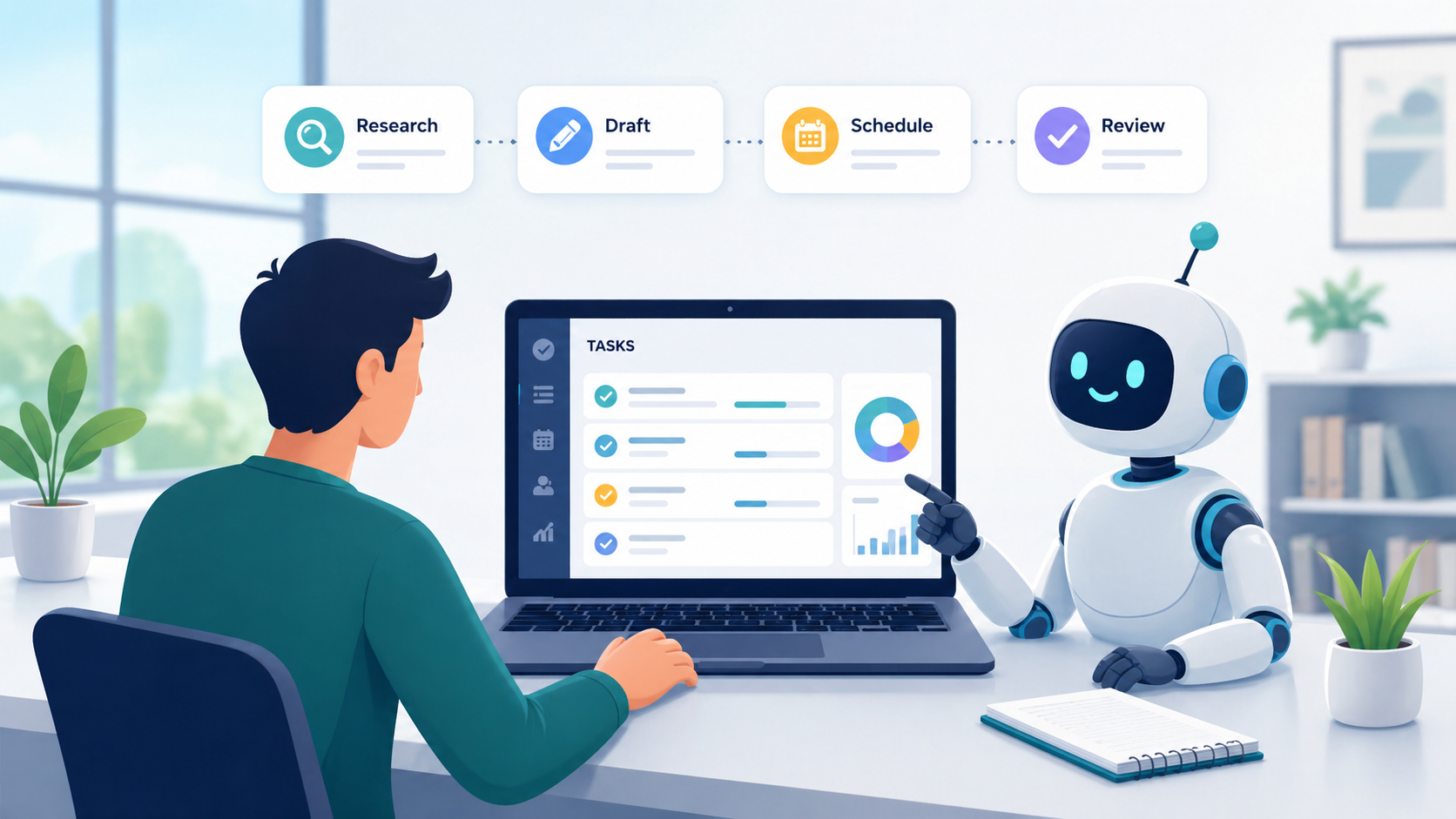
For example, a normal AI chatbot might help you write an email. An AI agent could research the topic, draft the email, schedule a follow-up, organize related files, and remind you when the person replies.
This is why AI agents are being called the next major step after generative AI. Generative AI creates content. AI agents help get work done.
Why AI Agents Are Trending Now
AI agents are trending because people do not just want more tools. They want tools that reduce effort.
Every day, workers spend time switching between apps, searching for information, writing updates, tracking tasks, answering messages, and managing repetitive workflows. AI agents promise to connect these scattered actions into one smoother process.
Industry research also shows strong momentum. Gartner predicted that 40% of enterprise applications will include task-specific AI agents by the end of 2026, up from less than 5% in 2025. Gartner also noted that agentic AI is moving enterprise apps beyond individual productivity toward smarter workflow collaboration.
That means AI agents are not just a technology buzzword. They are quickly becoming part of mainstream software.
How AI Agents Work

AI agents helping humans automate productivity tasks
Most AI agents follow a simple workflow:
- Understand the goal
- Plan the steps
- Use tools and data
- Take action
- Ask for approval when needed
- Improve through feedback
This is what makes AI agents different from simple automation. Traditional automation follows fixed rules. AI agents can reason through flexible tasks.
The Biggest Benefits of AI Agents
1. They Save Time
The most obvious benefit is time savings. AI agents can handle repetitive tasks such as summarizing meetings, drafting reports, checking documents, creating task lists, and organizing information.
For professionals, this can free up hours every week. For businesses, it can reduce delays and help teams move faster.
2. They Reduce App-Switching
Modern work often requires jumping between email, chat, documents, calendars, project tools, spreadsheets, and CRM platforms. AI agents can connect these tools and reduce the need to manually move information from one place to another.
This creates a smoother workflow and lowers the mental load of managing too many apps.
3. They Improve Decision-Making
AI agents can collect and summarize information quickly. Instead of searching through dozens of documents or messages, users can ask an agent to find the most important details.
This helps teams make faster and better-informed decisions.
4. They Help Small Teams Do More
Small businesses, creators, and solo professionals often do not have large teams. AI agents can help with marketing, customer support, research, planning, content creation, and admin work.
This makes advanced productivity tools more accessible to people who previously could not afford large teams or expensive systems.
5. They Support Better Customer Experiences
AI agents are also becoming important in customer service. They can answer questions, recommend products, help users solve problems, and escalate complex cases to human staff.
Adobe’s 2026 AI and Digital Trends research found that companies are looking at agentic AI for customer experience, employee support, sales, and customer interactions, although many organizations still face readiness gaps around data, infrastructure, and trust.
Real-Life Examples of AI Agents
AI agents can be useful across many industries and personal workflows.
A marketing agent can research trending topics, create content ideas, draft posts, and prepare a publishing calendar.
A sales agent can identify leads, summarize customer history, suggest follow-up messages, and update a CRM.
A customer support agent can answer common questions, check order details, and route difficult issues to a human representative.
A personal productivity agent can manage reminders, summarize emails, prepare meeting notes, and help plan the day.
A research agent can scan multiple sources, summarize findings, compare options, and produce a structured brief.
The common pattern is simple: AI agents help turn a goal into action.
Why Human Control Still Matters
AI agents are powerful, but they should not replace human judgment.
The best use of AI agents is not blind automation. It is human-guided automation. People should still review important outputs, approve sensitive actions, check facts, and make final decisions.
This is especially important when AI agents deal with money, personal data, legal topics, medical information, business decisions, or customer trust.
Adobe’s research highlights this balance clearly: customers are curious about AI agents, but comfort levels drop when agents handle sensitive information or important decisions. Transparency and easy access to human support remain important for trust.
In other words, AI agents work best when they assist people, not when they remove people from the process entirely.
Challenges of AI Agents
Like every major technology trend, AI agents come with challenges.
The first challenge is accuracy. AI can still make mistakes, misunderstand instructions, or produce incomplete information. Human review is still necessary.
The second challenge is privacy. AI agents often need access to emails, files, calendars, customer records, or business systems. Users must understand what data the agent can access and how that data is protected.
The third challenge is over-automation. Not every task should be automated. Some work requires empathy, creativity, negotiation, or careful human judgment.
The fourth challenge is integration. Many companies still have disconnected data and tools. Adobe’s 2026 report found that many organizations are ambitious about agentic AI but still lack the foundations needed to scale it successfully.
These challenges do not make AI agents less important. They simply show that the technology must be used carefully.
How to Start Using AI Agents
The best way to start is with low-risk, repetitive tasks.
You can use AI agents for:
- Summarizing long documents
- Creating meeting notes
- Drafting blog posts or emails
- Organizing tasks
- Building simple reports
- Researching topics
- Planning content calendars
- Preparing customer support replies
- Automating routine admin work
Start small. Review the results. Improve your instructions. Then expand to more complex workflows once you trust the process.
For businesses, the smartest approach is to define clear use cases first. Instead of adopting AI agents just because they are popular, teams should ask: Which tasks waste the most time, repeat often, and have clear success criteria?
That is where AI agents can deliver the most value.
The Future of AI Agents
AI agents are likely to become part of everyday digital life. They will appear inside work apps, browsers, smartphones, design tools, customer service platforms, and business systems.
Google Cloud’s 2026 AI agent trends report describes agentic AI as a major shift that can redefine roles, workflows, and business value.
In the near future, people may not open ten apps to complete a task. Instead, they may give one instruction to an AI agent and review the finished result.
That does not mean humans will become less important. It means human work may become more focused on goals, creativity, strategy, and judgment, while AI agents handle more of the repetitive steps in between.
Conclusion
AI agents are one of the most important technology trends of 2026 because they move AI from conversation to action.
They can save time, reduce repetitive work, improve productivity, support customer service, and help people manage complex workflows. But they also require careful use, clear human oversight, strong privacy practices, and responsible decision-making.
The future of productivity is not just about working faster. It is about working smarter.
AI agents are showing what that future could look like: humans setting the direction, and intelligent systems helping turn ideas into results.