
NASA’s Artemis II mission did more than send four astronauts around the Moon. It reopened a chapter of human spaceflight that had been closed since the Apollo era and gave the public a vivid reminder that lunar exploration is no longer a distant promise. It is happening now.
Launched on April 1, 2026, and completed with a splashdown on April 10, 2026, Artemis II marked the first time humans traveled to the Moon in more than half a century. That alone made it one of the defining science and space stories of the month. But the bigger reason it is resonating so strongly is simpler: people are not just searching for what happened. They are searching for what comes next.
What Artemis II Actually Did
Artemis II was a crewed lunar flyby, not a moon landing. Its main purpose was to test the systems NASA plans to use for future deep-space missions, including the Orion spacecraft and the Space Launch System rocket, with astronauts on board.
The mission carried four astronauts on a roughly 10-day trip around the Moon and back to Earth. During the flight, the crew traveled farther from Earth than any humans had before, reaching about 252,756 miles from home at the mission’s farthest point. NASA also said the astronauts returned with thousands of images, including striking views of the lunar far side and Earth seen from deep space.
That matters because Artemis II was not only symbolic. It was operational. NASA needed to prove that its spacecraft, life-support systems, communications, mission procedures, and crewed deep-space operations could work together under real conditions. By NASA’s early post-mission assessment, the flight provided exactly that kind of data.
Why This Mission Feels Bigger Than a Test Flight

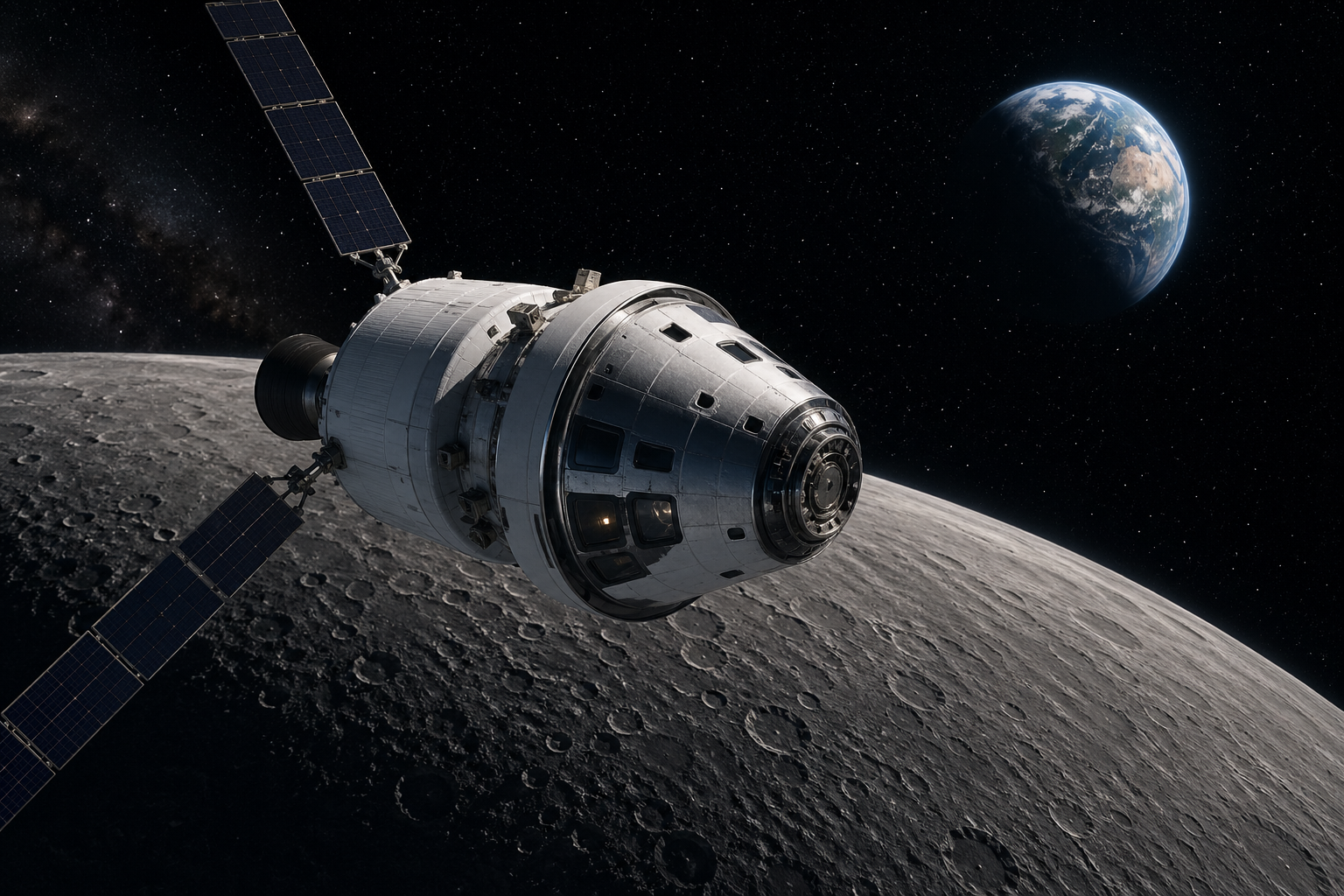
An original editorial image imagining astronauts looking out toward the Moon and Earth during a deep-space mission.
Technically, Artemis II was a test mission. In practice, it felt like a public turning point.
For years, space audiences have heard about humanity’s return to the Moon as a long-range ambition. Artemis II turned that ambition into something visible and immediate. People watched a crew launch, circle the Moon, and come home. That creates a very different emotional response than reading about future plans.
It also helps that Artemis II produced the kind of images and milestones that travel well beyond space enthusiasts. Historic firsts, record distances, views of Earth from lunar space, and the return of human lunar flight all make the story easy to share and easy to understand. That is a big part of why interest around the mission has stretched beyond launch week.
What Artemis II Means for NASA’s Moon Program
The simplest way to understand Artemis II is this: it was the bridge between planning and presence.
NASA’s Artemis program is designed to move in stages. Artemis II proved that astronauts can ride the current system safely around the Moon. The next stages are about building on that success with surface missions and a more durable lunar infrastructure.
According to NASA’s post-mission framing in April 2026, Artemis II laid the groundwork for:
- Artemis III
- later lunar surface missions
- a more sustained human presence near and on the Moon
- technologies and operational experience that support future Mars missions
That is why the mission matters even to readers who do not follow space news every day. Artemis II was not the finish line. It was the proof point NASA needed before attempting something more ambitious.
When Is Artemis III?
This is one of the biggest search questions attached to Artemis II.
NASA’s more recent 2026 planning materials point to 2028 for Artemis III under its updated roadmap. That is important because space timelines often shift, and readers are usually trying to sort out older expectations from newer plans. The safest way to frame it is that Artemis III is the next major step and NASA’s current planning points to 2028, not an immediate follow-up next month or next year.
For readers, that means Artemis II is best understood as the mission that reduced uncertainty. It showed the broader architecture can work with people on board. Now the attention turns to whether NASA can convert that success into a landing-era program with staying power.
The Real Reason People Care
There is a practical reason Artemis II is trending, but there is also a human one.
It reconnects modern audiences with a kind of exploration story that still feels rare. In an internet cycle crowded with short-lived distractions, Artemis II offered something bigger: a visible milestone in human progress, tied to science, engineering, risk, and wonder. Readers are responding not only to the facts of the mission, but to the feeling that they may be watching the early steps of a new space age.
That makes Artemis II especially strong as an article topic. It serves curiosity, explains a complicated story clearly, and gives readers a reason to keep following what happens next.
Key Takeaways
- Artemis II launched on
- It was the
- The mission tested the systems NASA plans to use for future lunar exploration.
- NASA’s early post-mission assessment says Artemis II is helping set up future missions.
- Current NASA planning points to
Conclusion
Artemis II is the strongest trend to build on today because it sits at the sweet spot of public fascination, search demand, and lasting relevance. It is a fresh story, but not a disposable one. Readers searching for Artemis II want more than headlines. They want context, clarity, and a sense of where this story goes next.
That is exactly what makes it a winning SEO topic right now.