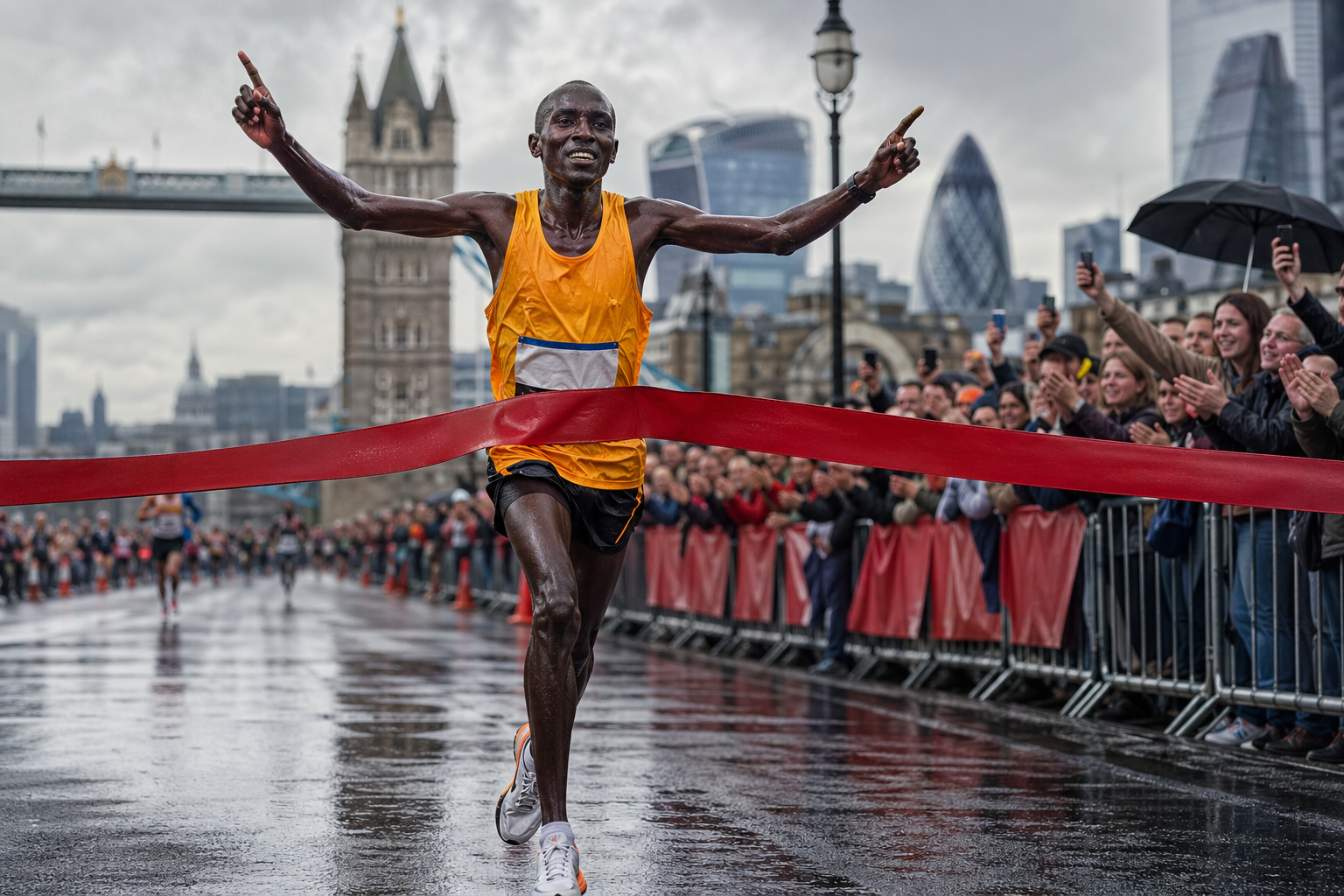

On April 26, 2026, the London Marathon delivered the kind of sports moment that instantly feels bigger than one race. Kenya’s Sabastian Sawe became the first man to run an official marathon in under two hours, finishing in 1:59:30 and rewriting what many people thought was still years away.
That is why the topic is still trending on April 28, 2026. It is not just another race result. It is a once-in-a-generation benchmark, the sort of achievement that pulls in hardcore runners, casual sports fans, and people who rarely follow marathons at all.
Quick summary
Sabastian Sawe won the 2026 London Marathon in 1:59:30.
It was the first official sub-two-hour marathon in a sanctioned race.
The performance also crushed the previous men’s world record.
The result matters beyond one athlete because it resets expectations for marathon running as a whole.
What happened in London
Sawe did not just sneak under a symbolic line. He broke through it decisively.
His winning time of 1:59:30 made him the first man to cover 26.2 miles in under two hours in official competition. That alone would have been enough to make headlines, but the full picture was even more dramatic. Ethiopia’s Yomif Kejelcha finished second in 1:59:41, and Uganda’s Jacob Kiplimo took third in 2:00:28. In other words, the race was not a one-man anomaly. The podium itself showed how far elite marathon running has moved.
That matters because sports history becomes more convincing when a landmark is not isolated. London did not feel like a lucky day with perfect conditions and one magical outlier. It felt like the sport had been pushing toward a new frontier and, suddenly, the door opened.
Why this is such a big deal
For years, two hours was treated as marathon running’s ultimate wall.
Runners, coaches, brands, and fans have chased it for decades because the marathon is one of the cleanest tests in sport. There is nowhere to hide across that distance. You need speed, patience, pacing, endurance, efficiency, and mental control, all at the highest level. Breaking two hours in an official race means one athlete put every part of that puzzle together on the day that counted.
The psychological impact may be just as important as the stopwatch. Once a barrier falls, it stops feeling mythical. It becomes real, and then it becomes chaseable. Future contenders will now train in a world where the impossible has already been done.
Was this different from earlier sub-two attempts?
Yes, and that distinction is crucial.
The marathon world has already seen high-profile attempts to break two hours in special exhibition conditions. Those efforts proved the barrier was physically possible, but they were not official world records because the setup did not meet standard competition rules.
Sawe’s run is different because it happened in sanctioned race conditions. That is what gives the result its historical weight. This was not a controlled demonstration designed around one athlete. It was a real championship-level marathon with real rivals, real pressure, and real consequences.
What made Sawe’s performance stand out
What stands out most is how complete the run was.
Sawe handled the distance, the pace, and the stakes without looking like he was surviving by instinct alone. He looked like an athlete executing a plan at the edge of human performance. The fact that Kejelcha was also under two hours and Kiplimo was barely over the previous record makes Sawe’s win look even more impressive, not less. He did not simply benefit from a fast race. He won the fastest deep-field marathon the sport has seen.
The result also strengthens Sawe’s status beyond a single headline. He is no longer just one of the best marathoners in the world. He is now attached to one of the sport’s defining breakthroughs.
What this means for the future of marathon running
The immediate effect is simple: expectations have changed.
Race organizers will now dream bigger. Elite fields will target faster pacing. Coaches will study London frame by frame. Shoe technology, fueling strategies, and race tactics will all get renewed attention. Every serious contender will start asking whether the next historic mark is not sub-two, but how far below it the sport can go.
That does not mean records will suddenly fall every month. The marathon is still brutally hard, and historic days stay historic because they are rare. But the ceiling just moved, and once the ceiling moves, the whole sport starts to rise toward it.
Final takeaway
Sabastian Sawe’s 1:59:30 at the 2026 London Marathon is more than a record. It is a turning point.
That is what makes it the strongest trending topic today. It carries the urgency of breaking news, the clarity of a major milestone, and the long tail of a story people will still be searching for weeks from now. For readers, it offers something better than hype: a real piece of sports history, still fresh, and still sinking in.
Sources: SpikeSearch trending list, AP News race report, World Athletics report, London Marathon Events recap