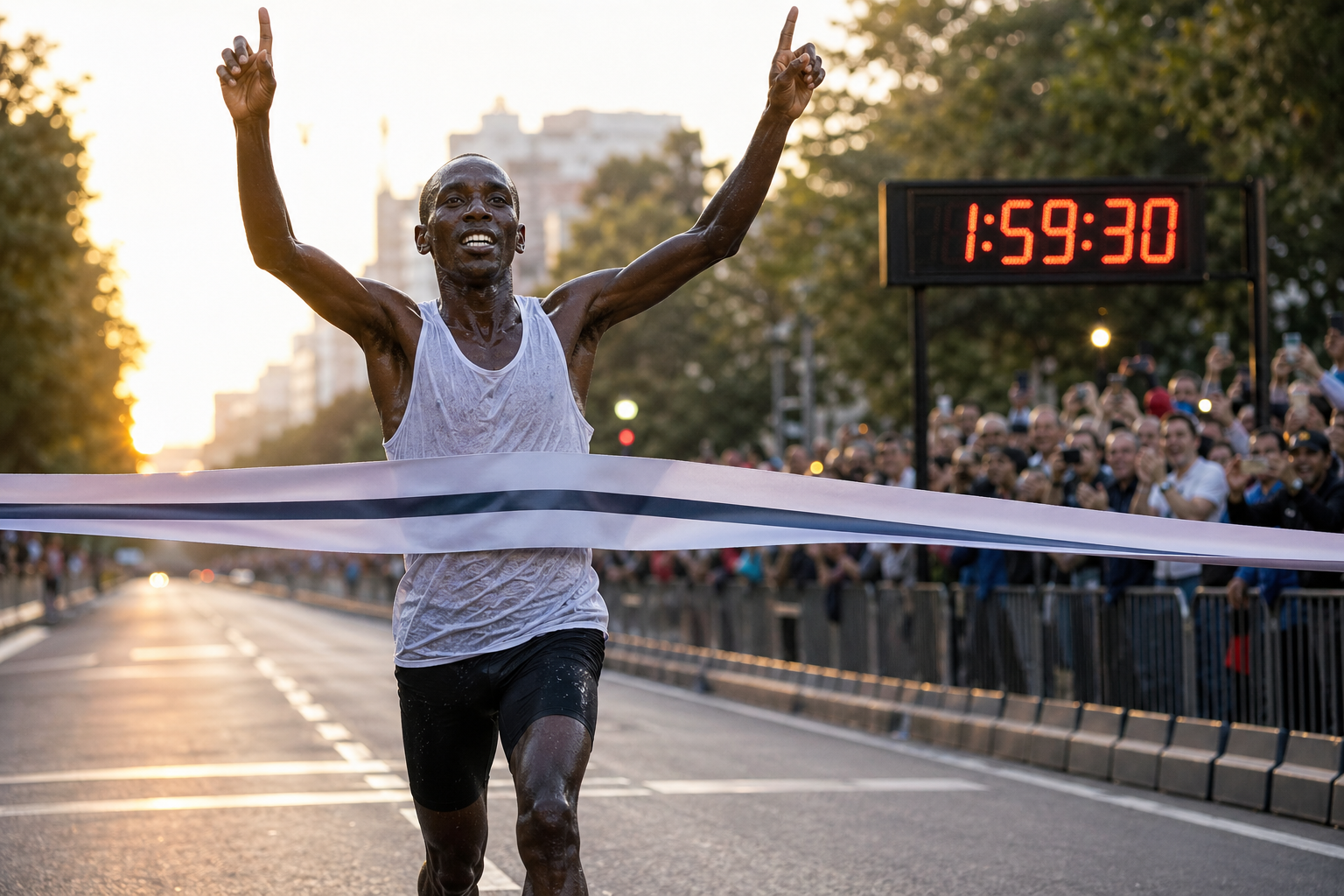

On April 26, 2026, marathon running crossed a line that had felt almost mythical for decades. At the London Marathon, Kenya’s Sabastian Sawe finished in 1:59:30, becoming the first athlete to run a marathon under two hours in an official, record-eligible race.
That number is why this story is exploding in search today. It is not just another race result. It is one of those rare sports moments that instantly becomes a before-and-after marker.
Quick Summary
Sabastian Sawe’s London performance matters for three reasons. First, he set a new world record. Second, he broke the two-hour barrier in a race that counts officially. Third, he did it in one of the most visible marathons in the world, turning a specialist running story into a global sports headline.
What Happened in London
Sawe won the men’s race at the 2026 London Marathon in 1:59:30, cutting deeply into the previous men’s world record and doing something the sport had chased for years. The performance immediately reshaped the conversation around what is physically possible over 26.2 miles.

An original wide race visual showing elite runners pushing a historic pace through a city course.
The women’s race added to the scale of the day as Tigst Assefa also delivered a record-setting performance, which helped make London feel less like a normal marathon weekend and more like a hinge point in endurance sport.
For casual readers, the headline is simple: marathon history changed in one morning.
Why the Two-Hour Barrier Means So Much
Every sport has a number that becomes symbolic. In the marathon, that number has long been two hours.
Runners, coaches, brands, and fans have spent years circling it because the barrier sits at the edge of human endurance. It represents speed, efficiency, pain tolerance, pacing discipline, fueling precision, and ideal race conditions all coming together almost perfectly.
That is why the achievement lands beyond hardcore running audiences. Even people who never watch marathons understand what “under two hours” means. It sounds impossible because, until very recently, it effectively was.
Why This One Counts Differently
A lot of readers will remember Eliud Kipchoge’s famous sub-two performance in 2019. That run was unforgettable, but it was not eligible as an official world record because it took place under specially controlled exhibition conditions.
Sawe’s run in London is different.
This was an official major marathon, under normal competitive race rules, on a record-recognized stage. That distinction is a big part of why search interest spiked so quickly after the race. People were not just asking, “Did someone go under two?” They were asking, “Did it finally happen for real?”
The answer is yes.
What Changed in Running Overnight
Records do more than update a leaderboard. They reset expectations.
Sawe’s result will likely change how athletes, coaches, and fans think about elite marathon pacing. It will also intensify discussion around shoe technology, race strategy, course conditions, and how fast the next generation of marathoners might go.
There is also a commercial angle. When a barrier like this falls, interest spreads outward fast:
- More casual readers want to know how it happened
- More runners start wondering what modern training and gear can do
- More brands try to connect themselves to the moment
- More media outlets treat distance running like mainstream news instead of niche coverage
That widening circle is exactly what makes the topic so strong for an SEO-ready article today.
Why Readers Care Even If They Never Run Marathons
The best sports stories are rarely only about sport.
This one is about the moment a limit stops looking fixed. People are drawn to records because they compress years of effort into one result everyone can understand. A two-hour marathon is not interesting only because it is fast. It is interesting because it felt like one of those barriers that might keep moving further away forever.
Then suddenly it did not.
That emotional snap is what gives the story staying power. Readers are coming for the record, but they stay because it speaks to progress, pressure, belief, and the strange way a stopwatch can change how people see the human body.
Practical Takeaways
- Sabastian Sawe’s
- The result gives marathon running a rare mainstream crossover moment.
- Search demand is strong because the story blends history, science, sport, and human drama in one clean headline.
- This is the kind of topic that works well both as breaking-news coverage and as an explainer article with longer shelf life.
Conclusion
Some records feel temporary the moment they are set. This one feels different.
Sabastian Sawe’s London Marathon run on April 26, 2026 did more than win a race. It closed one chapter of distance running and opened another. The two-hour barrier was one of the last truly legendary numbers in sport. Now it has been broken in official competition, and the marathon will not be viewed the same way again.